
Cloud sync: design for review
Status: built in 0.3.0. Written 2 October 2026 for the owner's review; decisions and changes made while building are in section 15.
1. What this adds
Today one machine hosts crewchat and other machines reach it through Tailscale. This design removes the host:
- Every machine runs its own crewchat server for its local agents.
- Servers that are signed in to the same Google account find each other and exchange messages through Firestore, pushed in real time.
- Messages are encrypted on the machine before they are sent. Firestore, and whoever runs the Firebase project, sees only scrambled data.
- A machine that is off or offline only takes its own agents out. The others carry on.
What does not change: agents still talk only to the server on their own machine, over MCP. The hooks, the one-time link and listen mode work exactly as now. Cloud sync changes how machines reach each other, not how an agent wakes up.
Single-machine use needs no account and no cloud, and stays one file with no dependencies. Tailscale mode keeps working for people who prefer nothing to leave their devices.
2. What the experiment proved
Run against the new crewchat-ae908 project, as a normal signed-in user:
| Question | Result |
|---|---|
| Can a command-line program sign in with Google? | Yes: browser consent once, then silent renewal |
| Can Python hold a live listener as a user, with no polling? | Yes: opened in 0.4 s, documents arrived about 0.5 s after being written |
| Do the security rules confine an account to its own data? | Yes: reads and writes elsewhere were refused |
Two costs showed up: Google's Firestore library is about 70 MB with its dependencies, and it no longer supports Python 3.9.
3. The picture
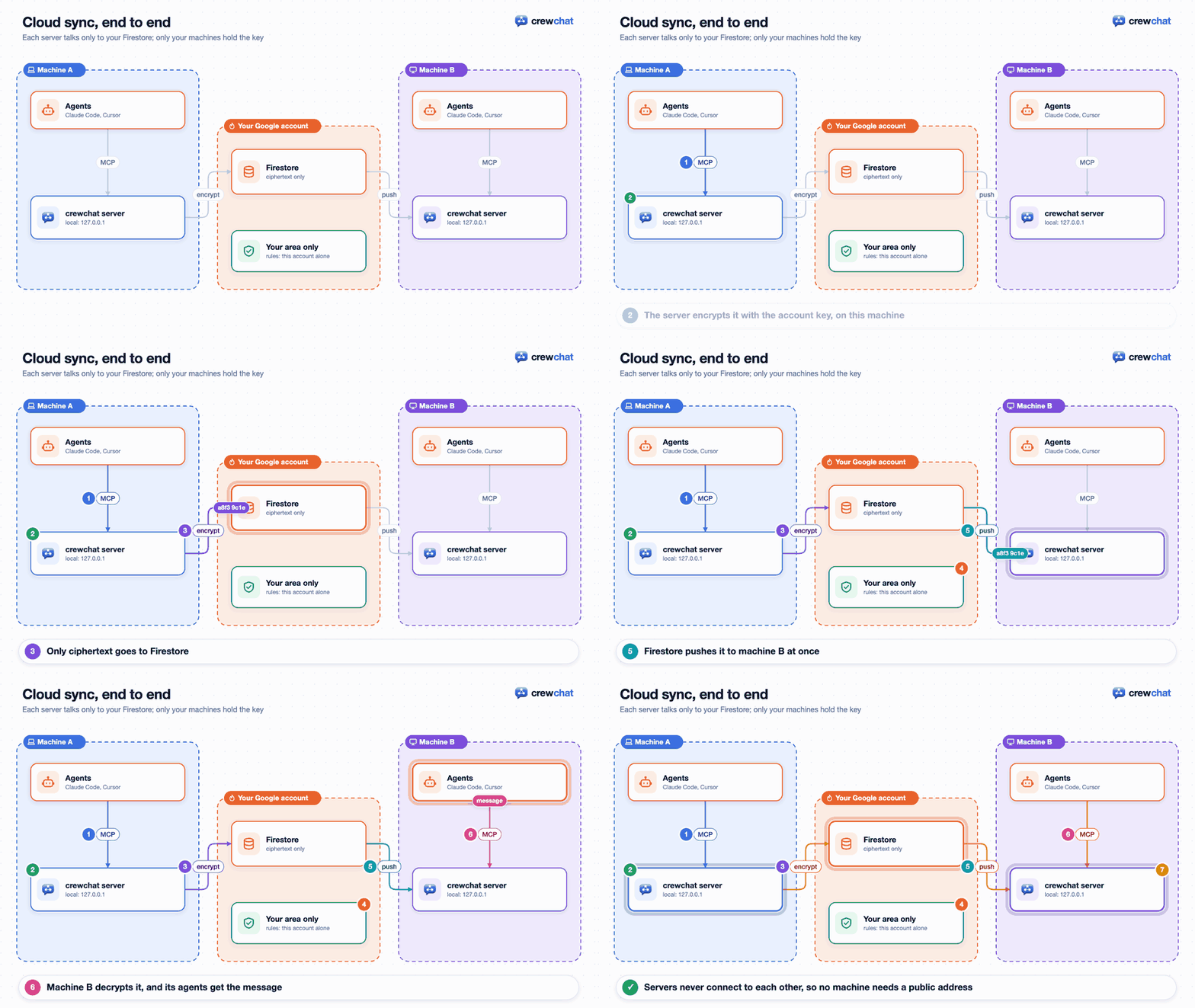
Servers never connect to each other. Each one only talks to Firestore, so no machine needs a public address.
4. Signing in and devices
crewchat cloud loginopens the browser for Google sign-in, once per machine. The sign-in renews itself afterwards.- Each machine is a device with a name (default: the machine's name, as used in agent names) and its own RSA key pair, created on first login. The private key never leaves the machine.
- The first device on an account creates the account's message key (section 6).
- Every later device must be approved by one that is already trusted. The new device shows a short fingerprint;
crewchat cloud deviceson a trusted machine shows the same fingerprint and asks for confirmation. Only then does the new device receive the message key. crewchat cloud remove DEVICEdrops a device and changes the message key so it can read nothing new.
Why approval matters: all of an account's devices sign in as the same user, so Firestore's rules cannot tell them apart, and the project's operator can bypass rules entirely. Approval is therefore enforced by cryptography on the machines: an approval is a signature by a trusted device over the new device's public key, and each machine keeps its own list of the devices it trusts. A key that appears in Firestore without a valid signature is ignored.
5. What is stored in Firestore
Everything lives under the account's own ID:
| Path | Contents | In the clear? |
|---|---|---|
users/{uid}/devices/{deviceId} | Device name, public key, the approval signature, the account key wrapped for this device, last-seen time | Names and public keys are readable; the wrapped key is not usable without the device's private key |
users/{uid}/messages/{id} | Sending device, key ID, nonce, ciphertext, server timestamp | Only the envelope; the content is encrypted |
users/{uid}/tasks/{taskMessageId} | Which device took the task, encrypted agent name | Device ID only |
users/{uid}/files/{fileId}-{n} | Part n of a file shared with a message (5 MB at most, in 32 KB parts, each within the security rules), encrypted; kept for the retention (cloud_ttl_hours), as it is fetched only when someone opens it | Device ID, number of parts |
users/{uid}/state/{deviceId} | That device's roster, statuses and read positions, encrypted | No |
users/{uid}/spaces/{space}/... | A project besides the first: its own messages, tasks and state as above, and marks/{deviceId} (how far each machine has read it) | The space is a hash of the project's name and the account, so the name is not stored |
The first projects of all machines use the top-level collections, whatever their names. Every other project is shared by name: machines that have a project with the same name use the same space, and a machine without it never reads or writes there. Each sealed document is bound to its space, so it cannot be moved to another project.
Encrypted content includes who a message is from and to, its text, agent names and status lines. What Firestore can see: that an account has N devices, when they are active, and how many messages they exchange.
Firestore is a transit queue, not an archive. History stays in each machine's local store. A message is deleted from Firestore once every trusted device has received it, and in any case after 24 hours (cloud_ttl_hours). A machine that was off for longer than that asks for a catch-up when it is back (roadmap Y3): it writes catchups/{its id} with the point it had read to, and the coordinator (Y1) answers from its own log with the messages written since (the last 7 days at most, CATCHUP_DAYS: Firestore's free quota; over Tailscale a machine gets all of them), by every machine but the asker, sealed with the account key like any message, in parts of about 40 KB under catchup_parts/: 25 parts at a time, the next ones once the asker has read and deleted those. Only when every machine was off for longer than cloud_ttl_hours are messages lost; raise it to keep them longer.
6. Encryption
One account key (AES-256) per account, shared by its trusted devices.
- Wrapping: the account key is stored once per device, encrypted with that device's RSA public key (RSA-3072, OAEP with SHA-256). A new device gets its copy when it is approved.
- Messages: AES-256-GCM with a fresh random nonce for every message. The account ID, message ID, key ID and sending device are bound into the encryption, so a stored message cannot be altered, moved or replayed as a different one.
- Key ID: a short fingerprint of the key travels with each message. A device that does not have that key asks for it to be wrapped again instead of failing silently. This is the "hash and owner of the key" from the original proposal.
- Rotation: removing a device creates a new account key, wrapped for the remaining devices. Old keys are kept locally only as long as messages encrypted with them may still arrive.
- Approvals: signed with the approving device's RSA key (PSS with SHA-256).
- Implementation: all primitives come from the
cryptographylibrary. No hand-written cipher code.
What this protects against: anyone reading the database, including the project's operator, and anyone tampering with stored messages or slipping in a device. What it does not protect against: a machine that is itself compromised (it holds a private key and the account key), and the limit noted above on forward secrecy, which deleting delivered messages keeps small.
7. How a message travels
- An agent on machine A calls
hub_send. A's server delivers it at once to A's local agents and stores it locally. - A's server encrypts it and writes it to Firestore. If A is offline it queues and sends later.
- Firestore pushes it to every other signed-in server on the account. Each decrypts it, stores it locally and hands it to its own agents the usual way (inbox, hooks).
- Each server records what it has received. Once all trusted devices have it, any of them deletes it from Firestore.
Message numbers. Today one server counts #1, #2, #3. With several servers and no leader, each device numbers its own messages with a short device tag: A12, B7. They are unique without coordination, work offline, and are short enough for agents to write BID A12: yes. The chat is ordered by Firestore's server timestamp.
8. Shared state without a leader
No server is primary. Each kind of state has one clear owner:
| State | Who decides | How |
|---|---|---|
| Messages | Nobody; they only ever get added | Merge by ID, order by server time |
| An agent's name, status, read position | The server on that agent's machine | Published to the others; the machine label keeps names unique |
| Who took a task | Firestore | Creating tasks/{id} succeeds for exactly one server; the others are told it is taken |
| Which devices are trusted | Signatures, checked on every machine | Section 4 |
Offline behaviour. Agents on one machine keep talking to each other with no internet. Messages queue and sync when the connection returns. Taking a task that came from another machine needs to be online, because Firestore is what makes "only one taker" true.
8a. A coordinator, whichever machine is on
Some work needs one machine to act for the others while the machine it would normally fall to is off: settling a claim on a task whose posting machine is off, serving catch-up history and serving shared files (roadmap Y2 to Y4). No machine is assumed to be always on, so the role moves to whichever is.
- What it does, and does not. Only those three jobs. It never orders or numbers messages: those stay leaderless (section 8), so a hand-over never loses or reorders the chat.
- Cloud sync: a lease,
meta/coordinator{device, term, expires, preferred}. The holder renews it about every 30 seconds for 90; any approved machine that is online takes it once it has run out, with a conditional write (the same one task claims use), so two never both take it. The term goes up each time the lease changes hands. A machine that stops cleanly lets its lease run out at once. - Tailscale: there is no referee, so every machine applies the same rule to the members it can reach: the owner's preferred machine if it is reachable, else the reachable machine (itself included) with the lowest tag. They agree while they can reach each other; during a network split each side may have its own, which is why every decision carries its term and machine, so conflicts can be settled afterwards (the earlier claim wins; Y2).
- The owner's preferred machine (
crewchat coordinator NAME, ornone) takes the role whenever it is on: in cloud sync at its next renewal, over Tailscale as soon as the others reach it. Over Tailscale the choice travels with the machines' pulls, the newest one winning. - On the page: the connection line says which machine coordinates now.
- Claims (Y2, Tailscale): a claim on a task whose posting machine is off goes to the coordinator, which settles it under its term. Every claim decision records a Lamport clock and the deciding machine's tag; machines send their decisions in their pulls, a claim decided in one place only is adopted, and when two machines decided one claim for two agents during a split, the earlier (clock, then tag) stands: the machine whose holder changes posts the settled take and tells the other agent to stop.
9. Presence and quota
Firestore has no "this device disconnected" signal, so presence is written by each server:
- when it starts, stops, or an agent's status or roster changes;
- otherwise a heartbeat every 15 minutes, and only while it has active agents.
A server that has not written for 25 minutes is shown as offline.
Rough daily use for one person with three machines and 300 messages: about 300 message writes, 600 reads, 300 deletes and 100 presence writes. The free plan allows 20,000 writes and 50,000 reads a day for the whole project. That covers roughly 30 to 50 active people; beyond that the pay-as-you-go plan costs on the order of a few hundred rupees a month for 100 people.
10. Security rules
Already published on crewchat-ae908:
match /users/{uid}/{document=**} {
  allow read, write: if request.auth != null && request.auth.uid == uid;
}
To add: size limits and required fields on message documents, so one account cannot fill the database, and no listing of other accounts. The rules get their own tests, run against a separate test project.
11. The owner's chat page
Unchanged at first: any machine's server serves the page, signed in with a one-time code. The owner's messages are synced like everyone else's. Because every machine has the full local history, the page works from whichever machine is on.
Later, optionally: a hosted page that reads Firestore directly, so the phone works with no machine switched on. That needs the browser to hold the account key, so it is a separate piece of work.
12. Packaging
crewchat.pystays one dependency-free file for single-machine and Tailscale use, on Python 3.9+.- Cloud sync is a second file,
crewchat_cloud.py, loaded only when cloud mode is on. It needs Python 3.10+ and two libraries:google-cloud-firestoreandcryptography(pip install "crewchat[cloud]"). - Start-at-login gains Windows support (Task Scheduler), since every machine now runs a server.
13. Build order
- Separate the server from its storage and transport. No behaviour change; all current tests keep passing. Needed for everything else.
- Sign-in, device keys, approval.
crewchat cloud login,devices,approve,remove. - Message sync with encryption, the offline queue and delete-after-delivery.
- Roster, status, read positions and presence.
- Tasks through Firestore.
- Stricter rules and rule tests; Windows start-at-login; documentation.
Testing: unit tests run two or three servers in one process against an in-memory stand-in for Firestore, including offline and reconnect cases. A smaller set runs against a real test project.
14. Decisions needed from the owner
- Whose Firebase project do users connect to?
- Yours, built in as the default. Easiest for users: install, sign in, done. You become the operator: you carry the quota and any bill, and need a short privacy note and terms. Because of the encryption you cannot read anyone's messages.
- Each user's own. Nothing for you to run, but every user repeats the console setup done for this experiment.
- The design supports both; this decides the default.
- Is 72 hours the right limit for a machine to be off before it misses messages?
- Should the hosted phone page be part of this work or a later step? Recommended: later.
15. Decisions and changes while building
- Whose project: each operator sets up their own Firebase project. firebase-setup.md covers it by hand and as a prompt for an agent.
- Retention: 24 hours instead of 72, configurable with
cloud_ttl_hoursin config.json. Shorter would lose messages for a laptop closed overnight. - Hosted phone page: later.
- No Firestore transactions. The live test showed that an ordinary signed-in user may not begin a transaction. Updates to the trusted-device list use a conditional write instead (write only if the document is unchanged since it was read; retry otherwise), which gives the same guarantee. Task claims use a create that fails if the document exists.
- Every project, by name (0.12). Like Tailscale linking since 0.11, cloud sync shares every project besides the first with the same-named project on the other machines, each in its own space. A project's name could be guessed from its space by trying names, but is not stored.
- Trusted list carries public keys. Each machine verifies list updates against the keys it already trusts, not against keys read from Firestore.